Showing posts with label Math. Show all posts

Tuesday, 28 February 2017

100 Day

The Grade One and Two classes joined up on Tuesday, February 28th to celebrate the 100th day of school this year.  The IPad app called Aging Booth was a big hit to help us imagine what we will look like when we are 100 years old!


Our Smartboard and the one in the Grade One room were both in use to work on 100 charts.


 A 100 snack was counted out with 10 groups of 10 foods. That was a popular station!

Stacking 100 cups and making groups of 5, 10, 20 and 25 were educational and knocking them down was fun!


Thanks to our visitors who took time to join in the morning and help us celebrate the day!


Thursday, 26 November 2015

Happy 50 Day!

It's hard to believe we've been at school for 50 Days already!  Today was a day of fun and counting in Grade Two!  We started the day with skip counting to 50 by 2's, 5's and 10's and then also by 4's, 7's and even 20's.  Counting to 50 in 50's didn't take long!  We figured out that the kids in our class will turn 50 years old in the years 2055 or 2056!


The students were challenged to create a recipe with 5 ingredients that totalled 50 items.  Then they had to make another recipe, in case there wasn't enough to make their first idea.  Students did a great job partitioning the number 50 into smaller units.


Happy 50 Day!

Thursday, 20 November 2014

The Fiftieth Day of School!

Wow!  Can you believe that today (November 20) was the fiftieth day of school this year?  To celebrate the occasion, Room 21 participated in a number of activities all day around the theme of "50".
Using a stamp pad and stamps, students thought about all the ways to make 50 cents with coins.
Students created necklaces with 50 Froot Loops in a pattern.  Later, they got to learn about subtraction first hand - by eating  them!

On this sheet, students had to imagine their life when they are 50 years old - in the years 2056 or 2057! 

This writing activity had the kids think about what they would like 50 of and if that would cause any problems!

They also were challenged to make a list of 50 food, people they knew, 3 letter words, or animals.  This had them work on thinking in categories to help with their list.  For food, they could name breakfast foods, then fruits, then green food to help them come up with a complete list.  They found that 50 takes a lot of thinking!

Other paper activities had them working with a 50 chart to see patterns and number sequence.

And finally, our new Smartboard was one station where the kids could try out the new pens and new way to erase.  Ask your child about it!
I hope that the day halfway to Hundred Day was a day of fun and learning in the Grade Two-Three class!

Monday, 3 November 2014

Power of Nine!

Following the success of our first two Math Strategies - Rainbow Numbers (that make 10) and Doubles/Near Doubles, our next focus will be on numbers added to nine and when 9 is taken away from a number.  This is a cute video that helps explain the strategy:

Here is another one by Classroom Professor that helps explain the strategy to parents.


For those who have these facts memorized, the next step will be mentally adding a 2 or 3 digit number with 9 like 45 + 9 and 9 + 123.

Don't forget to turn around the practice and subtract too.  15 - 9,  13 - 9 as well as 13 - 4 and 17 - 8.  We call it "The Power of Nine" and make a muscle to show the power that number has!

Friday, 31 October 2014

Happy Halloween!

It certainly makes Elementary teachers (and parents) happy when Halloween falls on a Friday!  The day can be a fun break from the ordinary and we don't have to come to school tomorrow with everyone tired or on a sugar high!  On October 31, the Grade 2-3's rotated through 5 stations to practice skills in a fun Halloween theme way.
Miss Martin, our Grade 11 student assistant, led the group in a game of Halloween word Bingo. The bingo "chips" were spider rings and other spooky things.

Mrs. Perreault led her group in some Math games using spooky dice.  In one game, called Spider, the object was to get the number 8 by adding and subtracting after rolling the dice.

I led a problem solving station where students read the clues on the Smartboard to decide how many ghosts and how many pumpkins were in their haunted house.  The picture below is the solution using bean counters for the following problem:
The number of pumpkins in your house is double three. 
 The ghosts and pumpkins in your house add up to 10 altogether.

 The IPads were used at the next station.  There were QR Codes that students could scan with the Ipad that would take them to Halloween books on videos on YouTube.

Another choice when at the IPads was to use the Cookie Doodle App to create a Halloween themed cookie.  Students could even eat the cookie, virtually of course!


 Another creating station was where students could make a card for someone to wish them a Happy Halloween. 


The day ended with treats and a party as well as visiting the haunted houses set up by Grades 7 - 12.  What a fun and memorable day at Reston School! 


Tuesday, 30 September 2014

Doubles, Doubles!

Doubles, Doubles, I can add doubles!
It's no trouble for me to add doubles!


Have you heard your child singing this song by chance?  (Mrs. Perreault said it was stuck in her head all day after hearing it in Math class this morning!)  Below are the links to the videos on YouTube:


The Math facts that we call The Doubles are the next set we focus on after mastering the Rainbow Numbers.  Knowing the answer in 1 or 2 seconds will help speed up computations but will also help with learning the "Near Doubles" facts like 7 + 6 and 8 + 9.  When practicing with your child, don't forget to turn them around to connect with the subtraction facts like 16 - 8 and 12 - 6. 

Monday, 15 September 2014

Rainbow Numbers

I just finished reading the parent replies to this week's TWAS (This Week At School) Journal entry and realized I should be explaining the term "Rainbow Numbers".

We are starting the year in Math being sure each and every student can quickly and easily say the number combinations that make 10-(7+3, 1+9, 4+6, etc).

The following video explains the thinking of these important numbers and shows where the name comes from.
Once they have mastered these facts, they can use them to help build numbers to any ten or even to 100 or 1000. 

This is a fun video that kids love singing along with. Be warned - it does say it might annoy parents!


Monday, 8 September 2014

Quilts


This year, we are starting off  with a theme about quilts.  A theme gives the class to learn in depth about a topic and connect our learning together.  We will read books about quilts, make them with geometric shapes in Math class, create paper quilts in art class and more.  We have read The Keeping Quilt, The Bear Paw Quilt, and The Quilt Story so far. 
 
Spelling with the theme started with thinking of words that start with qu and writing each on an index card.  The discussion turned to words with "qu" in them like equator and earthquake.  (Also how the word "choir" sounds like the others but is not spelled that way.)  The words were then put in a pocket chart and the next activities will include sorting them to the vowel sounds and looking for ending that make new words.  We will expand our vocabularies by talking about what the words mean and illustrating them.  I encourage the students to talk to their families about qu words and keep adding to our collection.
 
Quilts will also fit into our first Math study of Patterns.  We will make repeating patterns in a row but also make increasing and decreasing patterns and use symmetry to make 2 sides the same.  Keep watching this blog for more about our Quilt Theme!
 . 

Thursday, 8 May 2014

Mindreader

We learned a new Math game called Mindreader!  To play, you need three people and a deck of cards.

Two of the people put a card on their forehead so they can't see it and the third person, who can see them both, says the sum of the two cards. You hear the sum and you can see your friend's number.  Can you tell what is on your card without looking?

Okay, when you say the number of the card on your head you are not really reading a mind but doing some Math!  Try it yourself!
 

Wednesday, 30 April 2014

Timbits Math

This winter I  attended three Math sessions in Brandon put on by the Manitoba Rural Learning Consortium  (mRLC).  There I have had the chance to work with other Early Years teachers on  best practices for delivering the Math curriculum.  Thinking of the categories on the report cards for Mental Math/Estimation and Problem Solving, I felt I needed to learn more about planning and delivering effective lessons in these areas.
At the sessions, we were put into small groups and made a problem to try with our students.  For the final session on April 28, we came back to discuss what we found our classes could do and what to work on next.
 Here was the problem: 

The principal at our school would like to buy Timbits for two classes.  One class has 17 students and the other has 24.  Timbits come in boxes of 10.  How many boxes will he need to buy?
On Monday this week, I read the problem to the students and let them work on it.  I didn't give any other guidance to see what they could do independently.

  The Brandon session was on Tuesday and then on Wednesday, we worked on the same problem together as a class.  I listed the four answers that students in our room came up with and we worked through how they could have arrived at each answer and which was correct. Below are some samples of the students' work.


Overall, I was pleased with the results of  this problem and how they thought of ways to show their thinking.  It helps me plan for how to support the students who need extra practice and also to extend the learning for the ones who could solve this one successfully.

I brought Timbits back from Brandon too and everyone enjoyed the treat!  Our Timbits came in a box of  50.  If each of our 19 students ate two, how many were left to share with the staff in our building?  

They are also sold in boxes of 20.  What new problems could we create with that?

Tuesday, 15 April 2014

Happy Numbers

We have just started a new Math website called Happy Numbers.  Ms. Simms noticed that teachers on Twitter were talking about the free website that works on number skills and she set up accounts for all of us.

Add caption


One of our favourite games is Mini Bomb.  There are different levels of difficulty in this game but students need to answer the Math fact questions before the bomb explodes.  It challenges us to work quickly and use strategies and memories rather than counting to find the answers.


Another game is Buy Yourself a Toy where we are given a "wallet" of coins and we need to count them up to find which toy we have enough money to buy.  We have quickly learned that it is easier to start with the largest coin first when we count.


Our teacher thinks that the best part about this website is the way students can work through the standard Math algorithms and receive instant feedback of whether their answer is right or wrong.  Most computer practice doesn't have any place to carry the one as is shown in the picture above.  Ms. Simms overheard one student making an exciting discovery using Happy Numbers - "You can carry a two sometimes too!"
 
Here is another review by a teacher of the Happy Numbers website.  Our user names and passwords are glued into the front of our agenda.  We hope you will try it soon!

Measuring Puddles!


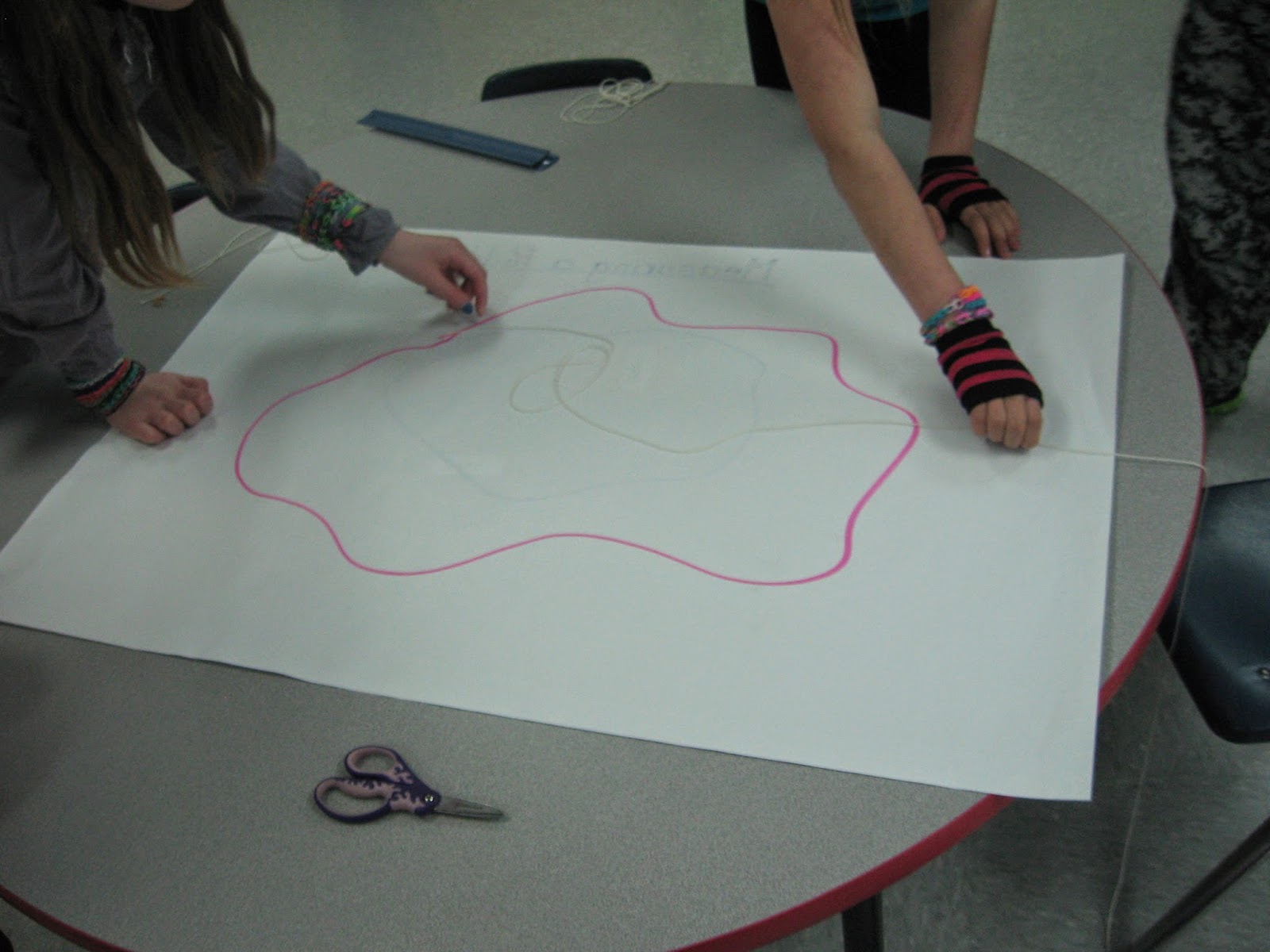
 It is that time of year!  Puddles are everywhere. I used this opportunity to introduce the measurement topic in Math class.  Students arrived in the morning with a big piece of paper on their tables where I had drawn a big puddle.  They were given the task to measure their puddle!


 After a few seconds, some kids started heading for the meter sticks and rulers that we have in our classroom.  We have a big ball of string in our room that we are using for an Art project and I said that it may come in handy too.  It was exciting to watch the cooperative measuring and recording that happened next!  It was a chance for me to see what prior knowledge the students will bring to the study of measurement.  As I suspected, there was lots of measuring talk with "inches" and "feet" but with a bit of prompting, they remembered earlier work on "centimetres"and "metres".


How we could use the string was discussed as a group and it was compared to having to build a snow fence around the puddle to keep kids out!  Most of the groups have 4 members and all the hands were needed to hold the string down and then lay it along a metre stick.  The word "perimeter" was introduced and measurements were compared between the tables.

We made a list of some of the ways a real puddle could be measured.    We will return to this activity over the unit to help us think about units and measurement.  We will also work on the concept of area and how it differs from perimeter. Another way to measure is mass but we thought weighing the water in a puddle would be hard!
 I suggested to the students that they might want to try this activity at home as well.  Someone suggested that the depth of a puddle can be measured with rubber boots!  A great connection!


Friday, 28 March 2014

Smartboard Calendar

Here is our March Smartboard calendar.  We do this activity first thing every morning and the helper of the day leads it.   See if you can answer the question under each picture!


Notice the colour pattern of the squares.  What colour will the 29th of March be?  We have been working lots on patterning this month.  We can figure out what something will be in a pattern just by thinking about numbers. 


How many days have we been at school in March?  How many left until 24 days?


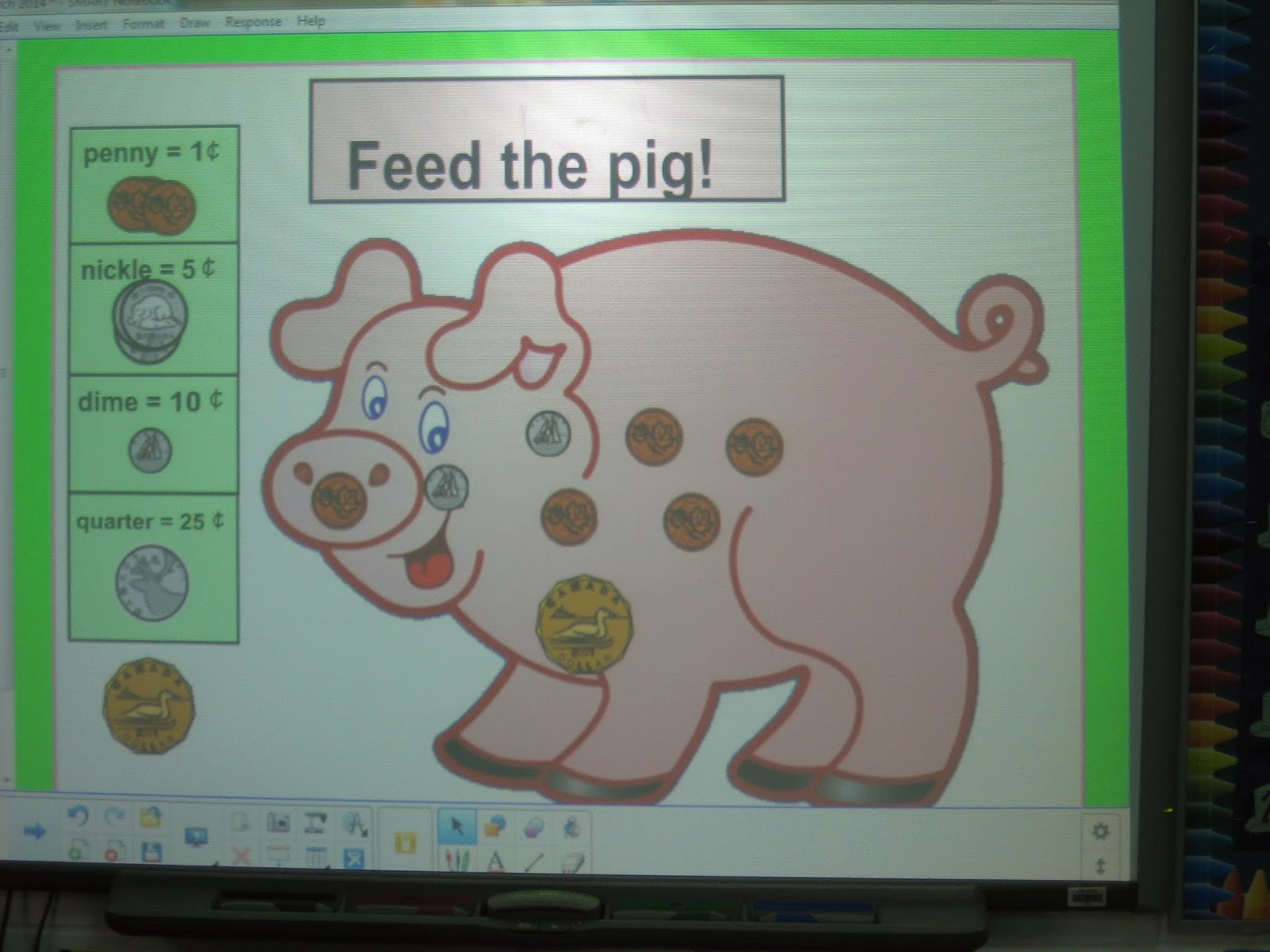
This was our 125th day of school so there is $1.25 in the piggy bank.  Can you make this amount with the fewest possible coins?


Were you right?


 This shows the number of days of school all year using Deines Blocks that show hundreds, tens, and ones.  How many days has it been since day 95? 


Next we create a line graph with the temperature outside each morning.  Do you see the coldest day in March on our graph?  How about the warmest day?


Here is the Environment Canada website for the temperature we have been using.  What is the temperature?


Now we have a weather station right on the roof of our school and here is that page.  How much different is this temperature from the one in Melita from Environment Canada?  Thank you to West Souris River Conservation District for the weather station and our tech department for getting us linked to it online.  There is a link to it from our school webpage.


This month, the helper has been deciding if the weather makes it a lion or lamb day.  Which has there been more of and how many more?


Here is the last slide of our calendar.  We list the students' names who are absent and write all 4 number facts for those numbers.  What facts would we write if five people are away?

Thank you for reading our blog!